Monday, June 14, 2010

The Crime of the Century

By Merel M.

On the evening of March 1, 1932, 20-month-old Charles Augustus Lindbergh Jr., was taken from his crib upstairs. No one knows how the kidnapper was able to get around without being heard by the child's parents.

A ten-week nation-wide search was undertaken. Ransom negotiations were also conducted. These resulted in the payment on April 2 of $50,000 in cash, part of which was made in soon-to-be withdrawn Gold certificates, in exchange for information. The information was false.

The search finally ended on May 12 when the remains of an infant were discovered by a truck driver close to the Lindbergh’s home. The child's body was soon identified as Charles himself, 2 miles from the family home in East Amwell, New Jersey.

A month later, the "Lindbergh Lawz" was started. This law stated that it would be a federal offense if a child was kidnapped and taken across state borders, unless the child had proper documents, or if mail was used to transport ransom notes across state lines.

Tracing of many Gold certificates passed in the New York City area over the next year eventually led police to 34-year old German immigrant carpenter, Bruno Richard Hauptmann. He was arrested near his home in The Bronx, New York, on September 19, 1934. A stash of $13,760 was found in his home: it was the ransom money. Six weeks later, he was convicted on all counts when, following just eleven hours of deliberation, he was immediately sentenced to death.

The Lindbergh family learned to get over their loss, but were tired of the never ending spot light on the family, so they moved to England.

No one knows whether the crook did it for the money or the kill. No one knows why Charles’s parents didn’t wake up to rescue their little boy. What we do know is that this crime was horrible, but also made it just a little safer for every child out there.

Information:
http://en.wikipedia.org/wiki/Charles_Lindbergh#.22The_Crime_of_the_Century.22

Saturday, June 12, 2010

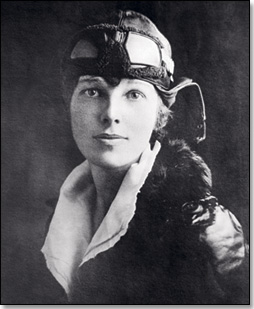
Amelia Earhart: Famous Flyer

by David L.

In this blog entry, you are going to be reading about Amelia Earhart’s free thinking ways and her marriage to the famous author and publisher George Putnam.

Who was Amelia Earhart?
Amelia Earhart was someone who wanted to try everything she saw. Most people think of Amelia as a flying lover and daredevil. But when she first saw airplanes, she did not like them and wondered why anyone would want to do anything like that. However, when she got asked to go flying by her father at an air field stunt show, and saw the great wonder of being up in the air, it set a new love. She married George Putnam, who was an author of many books like ``Hot Oil`` and ``In the Oregon Country``. When his business took off, he made a publishing business named George Palmer Putnam Inc, which published books like the Hardy Boys, the Bobbsey Twins, and Nancy Drew, as well as the Charles Lindbergh autobiography.

What did Amelia Earhart do?
Amelia lived near Kinner air field where she learned to race planes. She became the 16th woman to get a plane license.

Where did she live and travel?
Amelia Earhart moved around a lot and lived in places like Des Moines, Iowa. When she married George Putman, they lived in New York City.

When did her life occur?
Amelia Earhart was born July 24, 1897, and she was declared dead January 5, 1939. George was born September 7, 1887 and died of a kidney failure on January 4, 1950.

Why do we remember her?
The main reason Amelia wanted to fly was a result of a childhood experience. She was on a rollercoaster, and she liked the roller coaster so much that she wanted to do it again and again. One day, she sat on the roof in a box and slid down! She landed in a mangled mess at the bottom, emerged from the box and said to her friend, "Oh, Pidge, it's just like flying!" That was when everything took off.

How did she disappear?
Amelia’s disappearance is yet to be figured out, some people think that she ran out of fuel and crash landed in the ocean. No one has found the plane but remains of the flight suit have bean found.    

George Putnam was related to me by marriage.

Resources:
http://en.wikipedia.org/wiki/Amelia_Earhart

Betty Boop

by Meghan D. and Ranelle M.

Who:
Betty Boop was a famous cartoon character created in the 1920s by Grim Natwick. In an interview, Fleischer Studios said that Betty was only 16 in her films. Betty Boop wore short dresses, high heels, fake lashes, and a garter belt. She would also always show cleavage, and on screen they made her with a bit larger head to make her look younger but still like a flapper. When Betty Boop started her cartoons in no color or sound, the cartoons were quite popular. When she started in color, Fleischer said that the cartoon went slightly down in popularity. When sound came into play, she was first voiced by Margie Hines, but was soon joined by many other voice actresses. The most memorable was Mae Questal, who continued voicing this character until she died and was replaced with Tress MacNeille and Tara Strong.

What:
Betty Boop symbolized the flappers in the Roaring Twenties era. One of the reasons she was so popular was because she reminded people of the more carefree times before the Great Depression. She was also very popular because of her sexual appeal and is still popular now because of this. Because of her sexual contact and referral, her shows were mainly meant for adult audiences.

When:
Betty Boops first appearance was on August 9, 1930 in a cartoon called Dizzy Dishes, then carried on to Mini Moocher, her first film. In it she runs away from her parents with her boyfriend ‘Bimbo,’ and then they get trapped in a haunted cave. While trapped in the ghostly cave, a ghost named Walrus sings the famous song Mini Moocher and scares Betty back to the safety of her home. Also in 1930, she was named the ``Queen of Animated Screen` and her shows were popular all the way through the 1930s. Her appeal was slightly toned down in the mid-thirties. In 1933, Betty Boop’s sexual content in her films was restricted because of the film laws of the National Legion of Decency.

Where:
Betty Boop was first started and created by Grim Natwick in New York City. After that, she soon started her T.V. series which she also did in New York City, produced by Fleischer Studios.

Why:
Betty Boop represented the better times before the dirty thirties. People in the thiries were going through rough times and looked to Betty for a pick up. Grim Natwick created Betty Boop to earn money, and he needed to earn enough money to start his carrier as an illustrator. So when he started with Fleischer’s, he created Betty Boop to gain publicity.

How:
Betty Boop was first drawn in pen and ink by Grim Natwick, and produced by Fleischers Studios. Knowing that Betty Boop started in pen and ink ties in with one of her famous sayings: “Made of pen and ink, she will wink you with a wink.”

References:
http://raenae54.tripod.com/index-2.html.com
http://en.wikipedia.org/wiki/Betty_Boop

Babe Ruth

by Amy R. and Jenna D.

Who was he?
Babe Ruth is often referred to as the greatest baseball player of all time. He broke many records and had a very successful career in the sport of baseball.

Where was he born?
He was born on February 6th, 1895 in Baltimore, Maryland. He was the son of George Herman Ruth and Kate Schamberger and one of eight children, but only he and his one sister, Mamie, survived.

When did his baseball career take place?
Babe Ruth was 19 years old when he was launched into his very successful baseball career. He first played in the big league on July 11th, 1914 with the Boston Red Sox. His very last game was played on May 30th, 1935.

What is he famous for?
Babe Ruth is famous for many baseball records such as getting 714 home runs in 22 seasons. All together his talent and great personality made him famous and a fan favorite.

Why do we remember him?
We remember Babe Ruth for his all time record breaking career in baseball and for being a true American hero and role model for many. Not only was he a phenomenal baseball player, but also was a great person all around. He was very warmhearted and didn’t think of himself as being high and mighty just because he played with the Yankee’s. He wasn’t stuck up because of his fame. He was known for his love of children and was always seen helping out at orphanages and visiting sick children.

How did Babe Ruth affect the 1920s?
Babe Ruth is most recognized for his many record breaking accomplishments and for being a role model for any sport fanatic in the 1920s. He was known as the greatest player of the century. In 1919, he played for the Boston Red Sox and during that time set a record for the most scoreless innings in the World Series. Also during that time with the Red Sox, he hit 29 home runs, which was a new record. In 1920, he went and played with the New York Yankees. In his career, he set many records some of which were hitting 60 home runs in a year. That record stood unbroken for at least 34 years.

Interesting Facts about Babe Ruth:
For many years there has been a rumor floating around that Babe Ruth had to get someone else to run his bases for him due to his weight. After much research we have found that rumor to be not true. We found no evidence suggesting that someone had to run his bases for him in baseball. One of Babe Ruth’s friends, Ty Cobb, once said, “He runs okay for a fat guy.”


References:
http://library.thinkquest.org/C005846/categories/sports/sports.htm
http://www.u-s-history.com/pages/h1698.html
http://www.baseball-reference.com/teams/NYY/1927.shtml\
http://www.baseball-almanac.com/players/player.php?p=ruthba01
http://www.bbc.co.uk/dna/h2g2/A1117621

The Evolution of Twenties Dance Styles

Quickstep, Charleston, and Dance Marathons

by Morena S.

Where did it all start?
It started in America, influenced heavily by the Harlem area’s timed moves and short beats.

What dances were invented in this time?
Many dances were invented in the 1920s due to the US sponsoring dance contests where professional dancers invented new moves. The most influential and popular dances during this time are the Charleston, the black bottom, and the Lindy hop.

When were the dances invented?
Most of the dances were invented in the 1920’s. The Charleston was one of the first, becoming popular from its feature on two Broadway shows in 1922. After came the Black Bottom, most popular from 1926 to 1927. Then in 1927, the Lindy Hop took over and became the most popular social dance. The Lindy Hop eventually evolved into Swing dance.

Why did dancing become so popular?
In the 1920s, the introduction of electric lighting made dancing late into the night more comfortable. These places were called dance halls, which had live music playing for the dancers. It also helped that the restrictive clothing of the Victorian era was over, and that the new style was quite free and flowing.

Who were the dancers?
The general population who partook in the new generation of dancing was the youth at the time. The older and more conservative generation thought these styles of dancing scandalous, besides most of the dancing took place at parties or nightclubs.

How did dance marathons come to be?
Dance Marathons, or Walkathons, came around as human endurance competition. They became more popular during the depression because of their promise of a roof over the contestants heads and food twelve times a day. It also helped that there was prize money involved. They were called walkathon’s at the time because the churches still considered dancing a sinful act. Only later on were they remembered for what they truly were.

Resources:
http://en.wikipedia.org/wiki/Roaring_Twenties#Dance
http://www.historylink.org/index.cfm?DisplayPage=output.cfm&file_id=5534

Amelia Earhart

By Danya B.

Amelia Mary Earhart, also known as “Lady Lindy” (or “Meelie” which was what her family called her), daughter of Samuel "Edwin" Stanton Earhart and Amelia "Amy" Otis Earhart, was born July 24, 1897 in Atchison, Kansas, USA. She was the 16th women in the world to be permitted her pilot license, and was well-known for being the first woman to fly alone across the Atlantic Ocean. Her husband was George P. Putnam, whom she married in 1931.

Amelia had planned to enter Smith College, but changed her mind to go to Columbia University, and enrolled in Medical Studies. Earhart was a nurse when the Spanish Flu pandemic hit. She had been helping many patients and even got diagnosed herself. She was hospitalized in November 1918, and was released in December of the same year. Eventually she decided to become a pilot.

When she was little, her dad took her to an air fair and she decided she absolutely hated planes, because they weren’t interesting at all. It wasn’t until her dad took her to a stunt show that she started enjoying planes, and dreamed of being a pilot because she liked the rush it gave her. A couple of years later, her dad took her to an amusement park, and while on the roller coaster it made her feel like flying, and since then, wanted to fly. She took flying lessons from Anita “Neta” Snook, an experienced female pilot. She had her very first flying lesson for only $0.75 on January 3, 1921.

When Amelia married George, they started planning their round-the-world trip and bought a new plane: the Lockheed Electra 10E, which she got in July 1936. Their first attempt was on St. Patrick’s Day 1937, but only made it to Honolulu when there were problem with the propeller hubs. After they were fixed, they ended up in the United States Navy’s Luke Field on Ford Island in Pearl Harbor. From there they packed up and carried on 3 days later from Luke Field, but had a tire blow on Luke Field and the plane had to be shipped back for repairs.

On the second try, they flew west to east because of weather problems¸, and left from Oakland to Miami, Florida, where they would officially announce their flight. Earhart and Putnam departed Miami on June 1, and arrived in Lae, New Guinea on the 29th with only 7000 miles left.

On July 2, Amelia and her co-pilot, Fred Noonan, left New Guinea and headed towards Howland Island. While in flight to Howland Island, Earhart and her partner had been experiencing trouble with their radio signals, which is most likely because of an antenna that was torn off during takeoff at Lae. In one of the last signals received, Amelia said that they were running low on gas, and in the very last transmission received, she stated their position (running line north to south), and speed (6210 kilocycles). The transmissions received were believed to have been sent close to or at Howland Island.

Spasmodic signals over the next couple of days were reported but were not accommodating to any information of where they could be. After there weren’t any new signals, Earhart’s crew started worrying and went searching. All searches for Amelia and Noonan ended on July 19, 1937, with total search costs at $4 million, mostly funded by her desperate husband! They were declared dead January 5, 1939. They were never found, but during the search they did find two skeletons: one which was a male, and the other which was a female - they seemed to be European, and had all the features of Amelia and her co-pilot.

There are many beliefs and stories of how they went missing, such as the plane they were flying ran out of gas and they bailed into the ocean. Another theory is that after they were out of reach to send transmissions, they flew for another 2 and a half hours to Gardner Island, but landed on a reef and died. There is still no explanation on how Amelia Earhart and her co-pilot Fred Noonan went missing, but it is unlikely that we will ever know.

Resources:
http://en.wikipedia.org/wiki/Amelia_Earhart
http://www.ameliaearhart.com/about/bio.html
Amelia Earhart Podcast from Stuff You Missed in History Class

Al Capone's Life Story

by Kyle M.

Who:
One of the best gangsters of all time was the one and only Al Capone, or better known as Scarface. Al Capone was born in 1899 and died on January 25, 1947.

What:
Al Capone was of the best gangsters of all time. He dropped out of school while in the sixth grade, at the age of fourteen. Al Capone was involved with two kid gangs when he was a kid, and he grew to be one of the best gangsters of all time. Capone's most notorious killing was the St. Valentine's Day Massacre. On February 14, 1929, four of Capone's men entered a garage at 2122 N. Clark Street. The building was the main liquor headquarters of bootlegger George "Bugs" Moran's North Side gang. Because two of Capone's men were dressed as police, the seven men in the garage thought it was a police raid. As a result, they dropped their guns and put their hands against the wall. Using two shotguns and two machine guns, the Capone men fired more than 150 bullets into the victims and that is how it got its name: the St. Valentine Day Massacre.

Where:
Capone worked mainly out of Brooklyn, New York.

When:
Al Capone's criminal activity occurred throughout the 1920s. When Torrio, Al Capone's gang boss, was shot by rival gang, his members consequently decided to leave Chicago. Al Capone inherited the "outfit" and became boss. The outfit's men liked and trusted him and obeyed Al Capone, calling him "The Big Fellow.”

How:
Al Capone dropped out of school in sixth grade at age fourteen, after he beat a female teacher, and after the principle verbally chastised him for the incident. After Al Capone quit school, he faced a life of low-paying jobs, so he joined the street gang led by Johny Torrio and Lucky Luciano.

Why:
Al Capone was finally caught and jailed due to tax evasion. The jury found Capone not guilty on eighteen of the twenty-three counts. Judge Wilkerson sentenced him to a total of ten years in federal prison and one year in the county jail. In addition, Capone had to serve an earlier six-month contempt of court sentence for failing to appear in court. The fines equalled $50,000, and Capone had to pay the prosecution costs of $7,692.29.

Resources:
http://www.angelfire.com/co/pscst/capone.html
http://www.chicagorg/history/capone.html